
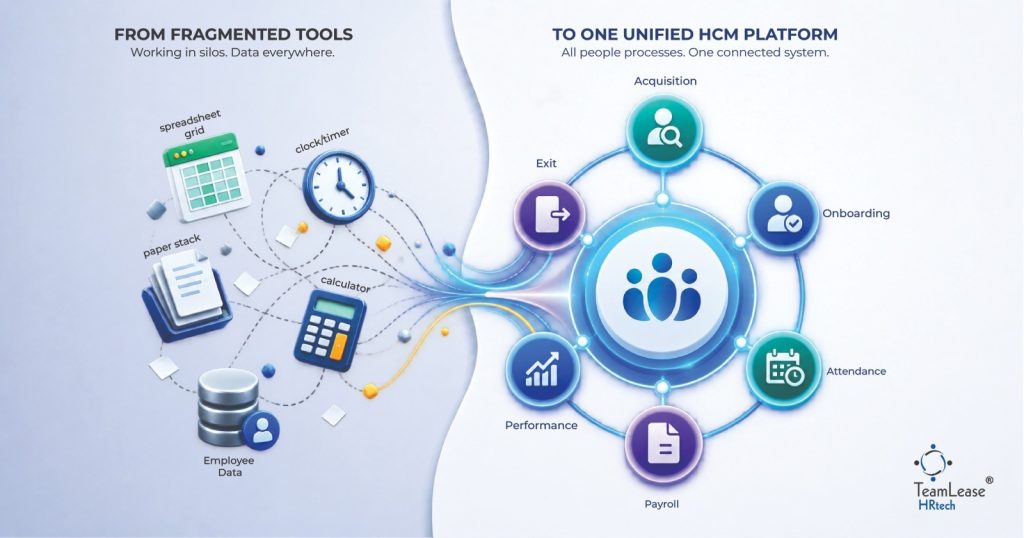
When an enterprise relies on disconnected software for attendance and payroll, it isn’t just managing administrative friction. It is paying a silent, compounding “spreadsheet tax”. While tracking hours and running monthly pay runs are operational essentials, treating them as the boundary of HR technology creates data silos and compliance vulnerabilities. In an era of multi-state and distributed workforces, a true Human Capital Management (HCM) platform must move beyond mere transactional processing.
The Tactical Fallacy of Point Solutions
In the evolving landscape of enterprise technology, organizations can frequently confuse basic administrative utilities with comprehensive Human Capital Management (HCM). For decades, HR technology operated in the shadow of broader enterprise software. It was viewed primarily as a back-office utility tasked with recording working hours and calculating monthly salaries.
In many emerging markets, particularly within complex corporate ecosystems, businesses remain tied to point solutions that digitized time-tracking using basic biometric terminals, while payroll was processed using spreadsheets or disconnected calculation engines, at best.
However, as organizations scale across geographically distributed sites, multiple legal entities, and shifting workforce structures, the operational toll of fragmented tools becomes unsustainable. Incorporating white-collar professionals, frontline workers, and field contractors begins taking a toll operationally. Coordination complexity grows non-linearly. Disconnected tools create data silos and administrative drag. In turn, this creates compliance blind spots that expose the business to severe operational risk.
Attendance and payroll are merely transactional endpoints. A true HCM platform must transcend basic transactional processing. The people function is reaching a strategic turning point where HR must serve as a system-level transformer rather than a simple administrative unit. It must act as a unified workforce architect, integrating every stage of the employee lifecycle into a single, secure platform built on a unified record that is the single source of truth. From smart talent acquisition and digital onboarding to skill development, performance optimization, and transition management — the people function must now look at the entire employee lifecycle.
The Architectural Anatomy of a Hire-to-Exit Lifecycle
An enterprise-grade evaluation of human capital technology requires assessing whether a system merely records events or actively orchestrates the complete employee journey. When lifecycle stages are managed in isolation, the gaps between systems create friction.
Below is a comparative breakdown of how basic point tools stack up against an integrated enterprise HCM framework across the core lifecycle touchpoints:
| Lifecycle Stage | Basic Point Tool Capability | Integrated Enterprise HCM Platform Capability |
|---|---|---|
| Smart Acquisition |
|
|
| Digital Onboarding |
|
|
| Time, Attendance & Roster Control |
|
|
| Deep Statutory Payroll & Compliance |
|
|
| Continuous Performance & Development |
|
|
| Offboarding & Transition |
|
|
The Business Case: Compliance, Productivity, and Economic Value
The transition from separate, unconnected HR tools to a unified HCM suite is driven by a clear financial imperative: eliminating what we can call the “spreadsheet tax.” Relying on manual data transfers across isolated software applications increases administrative overhead. This in turn significantly increases error rates. Disconnected systems introduce risks such as overpayments, unaccounted overtime, compliance penalties from missed statutory updates, and costly payroll disputes.
Quantifiable Operational Improvements
Deploying unified, cloud-native workforce infrastructure delivers measurable productivity and economic gains.
- Administrative Efficiency: Eliminating manual data re-entry and automating routine workflows yields up to a 21% improvement in administrative efficiency across HR operations.
- Error Reduction: Centralizing attendance, leave, and payroll into a single system of record achieves up to a 65% reduction in manual errors. This can drastically shorten payroll reconciliation cycles.
- Time & Cost Savings: Organizations consolidating their HR technology stack realize up to 30% savings in overall operational time and vendor management costs.
De-risking Regulatory Compliance
In complex labor markets with evolving regulations, automated statutory tracking is essential. Modern enterprises have to navigate multi-state regulatory environments across Provident Fund (PF), Employee State Insurance (ESIC), Professional Tax (PT), Tax Deducted at Source (TDS), and evolving national Labour Codes. Consolidating statutory frameworks requires workforce technology that automates compliance rules directly within salary engines. Treating compliance uniformly across all locations exposes enterprises to non-compliance penalties. A purpose-built HCM platform tracks and updates regulatory obligations at the state level in real time, thus negating any compliance-related risks.
Strategic C-Suite Alignment
By eliminating routine administrative bottlenecks, a unified HCM platform repositions the HR function from a tactical cost center into a strategic value driver. Organizations are facing critical tipping points that require them to move away from fragmented tools and toward human-centered, agile workforce orchestration systems.
Access to real-time workforce dashboards and analytics enables Chief Human Resources Officers (CHROs) and Chief Financial Officers (CFOs) to execute data-backed workforce planning that is more accurate and consistent.
Evaluating HCM Platforms: A Strategic Buying Framework
For enterprise procurement teams and HR leaders evaluating modern HCM platforms, vendor demos often over-index on surface-level user interfaces while obscuring underlying architectural limitations.
To ensure that a system can support complex operations at scale, evaluations should focus on four core criteria:
- Mixed Workforce and Unified Environment: Does the platform natively support the operational realities of diverse employee populations within a single environment? Is it capable of managing white-collar staff, deskless frontline workers, and field contractors?
- Localization and State-Level Compliance Engineering: Is regulatory tracking baked into the platform’s core payroll engine with automated state-by-state updates? Or does it rely on external add-ons and manual configurations?
- Mobile First Accessibility: Are core employee lifecycle capabilities such as geo-tagged attendance, claim submissions, pay slip access, and exit requests fully accessible via native mobile applications?
- Single Record Data Architecture: Does a single employee record flow seamlessly from candidate sourcing through performance management to offboarding? Does it require API middleware or involve a data re-entry exercise?
The Lifecycle Imperative
Viewing HR technology through the narrow lens of time-tracking and monthly pay calculations is an operational compromise that can limit the growth of an organization. In an era where agility defines market competitiveness, relying on a patchwork of disconnected point tools creates unnecessary friction and systemic risk.
Transitioning to a comprehensive, unified HCM platform is a strategic repositioning of the human resources function. More importantly, it is the foundation for any rapidly scaling organization. By unifying core HR, talent acquisition, workforce management, compliance, and performance onto a single source of truth, organizations build a resilient workforce infrastructure. This makes the enterprise capable of adapting to market shifts and driving long-term enterprise growth.
