
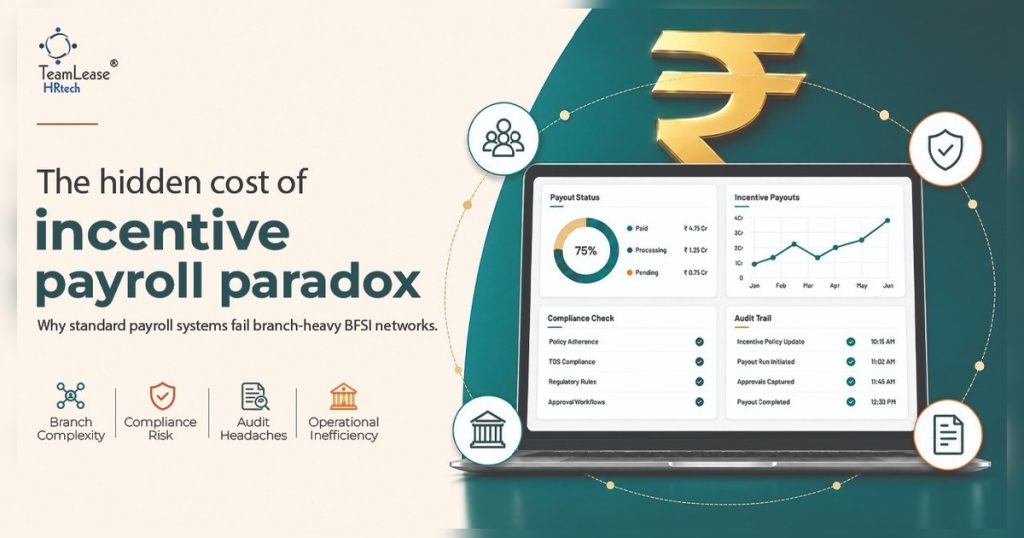
BFSI payroll incentive management is becoming a critical priority as BFSI organizations expand into new markets and build larger frontline sales networks. With that comes payroll complexity which is growing faster than payroll capability. Variable pay structures, incentive-linked compensation, clawbacks, statutory compliance requirements, and audit expectations are stretching conventional payroll systems to their limits. Forward-looking organizations are recognizing that payroll is no longer just a processing function, but a critical enabler of operational efficiency and regulatory readiness.
India’s Banking, Financial Services, and Insurance (BFSI) sector has become one of the country’s largest employers of frontline sales talent. From private banks and NBFCs to microfinance institutions and digital lending platforms, growth is increasingly powered by distributed networks of Direct Sales Agents (DSAs), Direct Sales Teams (DSTs), Feet-on-Street (FOS) personnel, relationship managers, and branch-based acquisition teams.
Yet while the business model has evolved dramatically, payroll infrastructure often has not kept pace with a rapidly evolving workforce.
Many organisations continue to rely on payroll systems originally designed for predictable salary structures and relatively stable compensation models. These systems work well for fixed-pay workforces, but they begin to be challenged when they have to work with current workforce environments in the BFSI sector. These tools show significant limitations when applied to environments where compensation is linked to performance, loan disbursements, collections, product mix, regional targets, and other incentive plans.
This leads to a scenario where the employees who drive revenue growth through variable incentives are often supported by payroll systems least equipped to process those incentives accurately, transparently, and at scale. This is what we describe as the Incentive Payroll Paradox.
The Hidden Complexity of BFSI Payroll
Effective BFSI payroll incentive management requires more than standard processing. In most industries, payroll is primarily a process of calculating salary, statutory deductions, taxes, and reimbursements. In BFSI organisations, however, payroll often becomes a complex operational exercise. It typically involves thousands of variable compensation calculations every month.
A loan sales executive’s payout could depend on a number of variables like product type, geography, ticket size, conversion ratios, achievement against targets, etc. These calculations frequently require adjustments. These adjustments are made for reasons like reversals, loan cancellations, delinquency-related deductions, and deferred incentive components linked to portfolio performance.
At the same time, financial institutions operate within highly regulated environments where governance, control, documentation, and auditability are critical business requirements. RBI regulatory frameworks continue to place significant emphasis on operational controls, governance standards, and risk management across regulated entities.
When compensation structures become this dynamic in a highly regulated industry, payroll ceases to be merely an HR process. It becomes a business-critical control function.
Failure Point #1: Fixed Payroll Engines Cannot Handle Dynamic Incentive Logic
The Dynamic Variable Pay Challenge
Most traditional payroll platforms were architected around a simple assumption: compensation is calculated elsewhere and then imported into payroll for processing.
For BFSI employers, this creates a fundamental limitation.
Variable pay is rarely static in the BFSI sector. Incentive plans evolve constantly in response to business priorities, product launches, risk considerations, and market conditions. Monthly payouts are often influenced by complex performance matrices. These can change across business units, product lines, and even geographies.
As a result, compensation teams frequently turn to spreadsheets to bridge the gap. Large teams spend substantial effort extracting sales data, applying incentive formulas, validating calculations, reconciling exceptions, and uploading final payout files into payroll systems.
This creates operational risks at multiple levels:
- Formula errors and manual calculation mistakes
- Version control issues across multiple spreadsheets
- Delayed payroll or payout cycles
- Disputes regarding incentive accuracy
- Limited visibility into payout calculations
Most importantly, the spreadsheet tends to become the “system of record” for incentive computation rather than the payroll platform itself. This model is increasingly unsustainable.
The Clawback Challenge
One of the most complex payroll challenges in BFSI environments emerges after incentives have already been paid. In many businesses, incentive payouts are linked not merely to loan origination but to the sustained quality and persistence of the underlying asset.
If the loan is cancelled, prepayment occurs within a defined period, an insurance policy lapses, or the account turns delinquent shortly after disbursement, the organisation may be entitled to recover all or part of the previously paid incentive.
While clawback policies are standard practice in many organisations, many payroll systems fail to operationalize them effectively. This leads to a heavily manual process that requires operations, finance, and HR teams to identify affected accounts, calculate recoveries, validate prior payouts, and process adjustments in subsequent payroll cycles.
For organisations with large branch networks handling thousands of loans or policies each month, these activities can become operationally intensive and error-prone. As institutions increasingly link incentives to portfolio quality, customer retention, and long-term business outcomes, the complexity of managing incentives continues to grow.
Hence, modern payroll systems must therefore support automated clawback workflows, transparent audit trails, and rule-based recovery mechanisms.
Failure Point #2: Compliance Complexity Cannot Be Managed Through Static Rules
The compliance burden facing BFSI employers continues to grow. Organisations operating branch networks across multiple states must manage Professional Tax variations, state-specific employment regulations, evolving tax requirements, provident fund implications, and social security obligations across thousands of employees.
At the same time, the recent labour reforms continue to reshape payroll governance. The evolving compliance landscape has made ongoing regulatory monitoring a business necessity, not an optional governance exercise.
The challenge becomes more pronounced when incentives constitute a significant component of total earnings. Changes in variable compensation can affect tax withholding calculations, statutory contributions, and reporting obligations. A static payroll setup that relies on periodic manual updates can struggle to keep pace with these evolving requirements.
As organisations expand into tier-2, tier-3, and rural markets, compliance complexity scales exponentially. What appears manageable for 500 employees can become a significant operational challenge at 10,000.
Failure Point #3: Processing Transactions Is Not the Same as Managing Accountability
Perhaps the most overlooked weakness in traditional payroll approaches is the absence of end-to-end accountability. Many payroll providers are structured around transaction processing. Their responsibility begins when data is submitted and ends when payroll is processed. For BFSI organisations, however, the most significant risks occur before payroll processing even begins.
Increasingly, organisations will have to pay attention to the following aspects:
- Was the source incentive data validated?
- Was the correct calculation logic applied?
- Were clawback policies accurately executed?
- Can every payout be traced back to a documented business rule?
- Is there sufficient audit evidence to support regulatory reviews?
This issue is especially relevant as financial institutions increasingly adopt risk-aligned compensation frameworks. Compensation policies across major financial institutions now include mechanisms for deferred compensation and clawback provisions.
The challenge is not just restricted to calculating these adjustments, as discussed earlier. The challenge is also demonstrating how they were calculated. Without strong audit trails, organisations could find themselves unable to provide sufficient evidence during internal audits, regulatory examinations, or employee disputes.
What an India-Ready Payroll Architecture Looks Like
The next generation of BFSI payroll incentive management requires a fundamentally different design philosophy. Rather than treating payroll as the final step in a process, modern systems integrate payroll directly into the broader compensation ecosystem.
Key characteristics include:
Direct Integration with Business Systems
Incentive calculations should originate from verified operational data sources such as Core Banking Systems (CBS), Loan Origination Systems (LOS), collections platforms, and sales-performance systems.
This reduces dependency on spreadsheets while improving accuracy and transparency.
Automated Clawback and Recovery Frameworks
Organisations need configurable rules engines capable of applying policy-driven deductions, reversals, and post-separation adjustments automatically.
Manual intervention should become the exception rather than the norm.
Dynamic Compliance Intelligence
Compliance management must move beyond periodic updates and become a continuously monitored capability. Continuous state-level regulatory updates for PT, ESIC, PF, and TDS, ensuring accurate statutory processing across expansive Indian branch networks, can add tremendous value to the organisation.
Payroll engines should be capable of adapting to regulatory changes, state-specific requirements, and evolving statutory obligations without creating disruption to business operations.
End-to-End Auditability
Every calculation should be explainable. Every adjustment should be traceable. Every payout should have a documented lineage.
As regulations and guidelines continue to increase across regulated sectors, audit readiness will increasingly become a bare minimum requirement.
Managed SLA Ownership
In BFSI environments, payroll errors can create financial, compliance, and employee-trust risks.
A managed payroll model will provide dedicated ownership across payroll operations. This will ensure accurate incentive payouts, timely processing, regulatory compliance, and complete audit preparedness through defined SLAs and expert oversight.
From Payroll Administration to Business Enablement
For many BFSI organisations, payroll is viewed primarily as a back-office function. That perspective is rapidly becoming outdated.
Frontline Retention
For incentive-driven frontline teams, payroll is a direct reflection of organisational reliability. Accurate and timely incentive payouts build trust, improve morale, and help reduce attrition in a highly competitive BFSI sales environment.
Operational Efficiency
Automating incentive calculations, clawbacks, validations, and reconciliations eliminates significant manual effort across HR, payroll, finance, and branch operations. This frees up teams to focus on business growth and workforce productivity.
Complete Audit Readiness
A modern payroll architecture creates a clear audit trail for every calculation, adjustment, and payout decision. This ensures faster responses to internal audits, statutory reviews, and regulatory examinations while strengthening governance and compliance.
For organisations navigating increasingly complex compensation structures, the question is no longer whether payroll can calculate salaries. That is a given. The real question is whether payroll architecture is sophisticated enough to support the realities of modern BFSI growth.
And in a sector where incentive structures drive performance, growth, and revenue generation, mastering BFSI payroll incentive management may ultimately become one of the most important workforce transformation priorities of the decade.
