
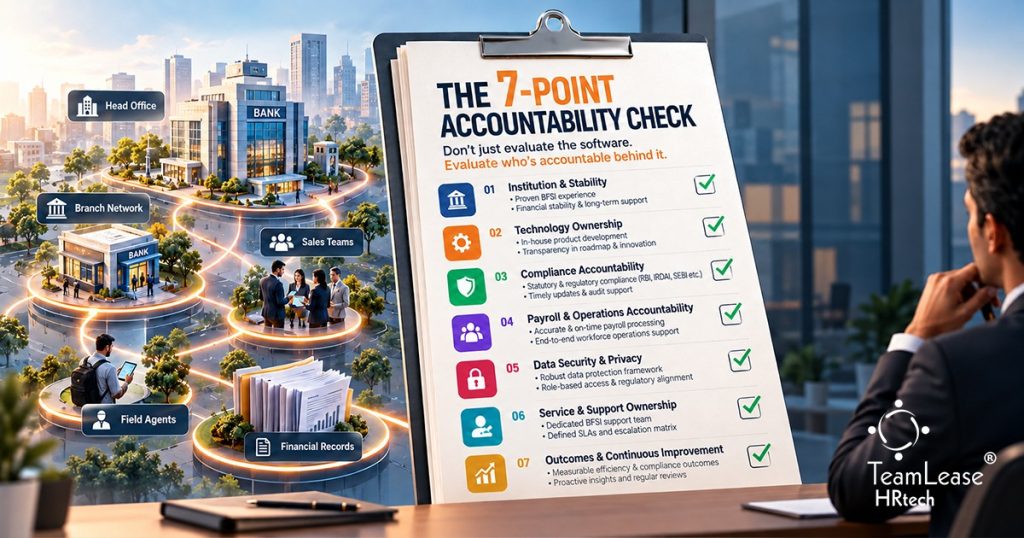
Evaluating an HCM partner as if it’s just a software choice—without regard to who’s actually accountable for payroll and compliance outcomes—is evaluating the wrong thing. A technically excellent HCM software with a shaky or fragmented payroll and compliance backing still leaves you vulnerable and exposed.
As a banking, financial services, or insurance firm with branches, feet-on-street agents, and sales teams spread across cities and states, you’re particularly exposed to the gaps that open up between HCM, payroll, and compliance. Combined with attrition that runs among the highest of any sector, this puts real pressure on how you manage your diverse workforce while staying compliant at scale.
This checklist works through what to actually look for in an HCM partner—not just the software, but also who stands behind it on payroll and compliance.
1. AI-Powered Recruitment
Ask This: Does the platform use AI to parse resumes and shortlist candidates against role requirements, with first-round screening through BOT-based audio or video interviews—or does every application still need a recruiter’s manual review before it moves forward?
Why It Matters: BFSI runs some of the highest attrition of any sector—private-bank attrition is at roughly 25% and the churn is sharper in NBFCs (~77% annual) and insurance (~62% annual), concentrated heavily in frontline and entry-level roles. At this hiring volume, manual screening becomes the bottleneck long before onboarding does—recruiters can’t review thousands of applications by hand across dozens of open roles at once. AI-assisted shortlisting keeps qualified candidates moving instead of piling up in a queue.
2. Onboarding at Scale
Ask This: Can employees complete onboarding themselves—digital offer acceptance, e-KYC, document upload—and does the data convert straight into the live Core HR employee profile without HR manually re-entering data or chasing paperwork?
Why It Matters: That same attrition doesn’t stop at recruitment—every fresh hire still needs onboarding, and at this frequency, onboarding can’t depend on HR’s bandwidth; it has to run itself.
3. Full-Scope Statutory Compliance
Ask This: Does compliance go beyond PF, ESI, PT, and TDS calculation to cover statutory registers and multi-Act filings—Factories Act, Shops & Establishments Act, Contract Labour Act—accurately, in every state you operate?
Why It Matters: PF, ESI, PT, and TDS calculations are automated by nearly all HR software in the market. What actually protects you sits one layer deeper: statutory registers, multi-Act filings, and staying current as India’s four Labour Codes reshape the rules. Banking and insurance fall under Central Government jurisdiction for these codes specifically—the applicable central rules were notified in May 2026, so this isn’t a future event to prepare for, it’s already the operating reality.
4. Compliance-Accurate Exit
Ask This: When an employee exits, is gratuity calculated against the current rules—the one-year eligibility for fixed-term and contract staff, the 50% basic salary rule—with TDS applied correctly?
Why It Matters: Exit compliance has quietly gotten more complex, not simpler. Fixed-term and contract employees now qualify for gratuity after one year of service instead of five, and gratuity must be calculated on a base where basic pay is at least 50% of CTC—a rule that invalidates past salary structures. Get either wrong, and a routine exit turns into a compliance notice or a dispute.
5. Contract & Agent Workforce Compliance
Ask This: If a contractor or vendor supplying your collection agents, direct sales agents, or field staff fails to deposit PF or ESI, or operates without a valid licence, does your compliance partner catch it before it becomes your liability—or only after?
Why It Matters: Principal-employer liability doesn’t transfer away with a contract—it’s non-delegable, you remain legally on the hook for a vendor’s compliance failures even with an indemnity clause in place, and an unlicensed contractor can mean the law deems those workers your direct employees. With collection agents, DSAs, and field staff often supplied through multiple vendors, that exposure multiplies with every relationship you’re not actively monitoring.
6. Works With Your Existing HCM Software
Ask This: If your payroll or compliance processes have gaps, does fixing them require replacing your existing HCM software—or can a managed payroll and compliance layer plug into what you already run, without a rip-and-replace?
Why It Matters: You’ve most likely already invested in HCM software—the real exposure usually sits in payroll accuracy and compliance depth, not the software layer. A partner that integrates natively with your existing HCM software lets you fix what’s actually broken without disrupting what already works.
7. One Accountability Chain
Ask This: When attendance data, a payroll run, and a statutory filing all touch the same employee record and something goes wrong, is there one team that owns the fix end-to-end—or do you have to chase down which vendor’s system was at fault?
Why It Matters: A fragmented vendor stack—one company for software, another for payroll, a third for compliance—turns every error into a three-way investigation before anyone even starts fixing it. One accountable partner across all three means one team owns the outcome, with nowhere to point the finger but at themselves.
One Partner, Every Checkpoint
TeamLease HRtech is built around exactly this—AI-assisted hiring, onboarding that runs itself, and statutory compliance that goes well beyond the basics. It integrates with your existing HCM software, so fixing payroll or compliance exposure doesn’t mean replacing what works. And because TeamLease’s managed payroll team and its compliance team and platform sit alongside the HCM software, there’s one team accountable for the outcome—not three vendors pointing at each other when something goes wrong.
See how TeamLease HRtech checks every box.
