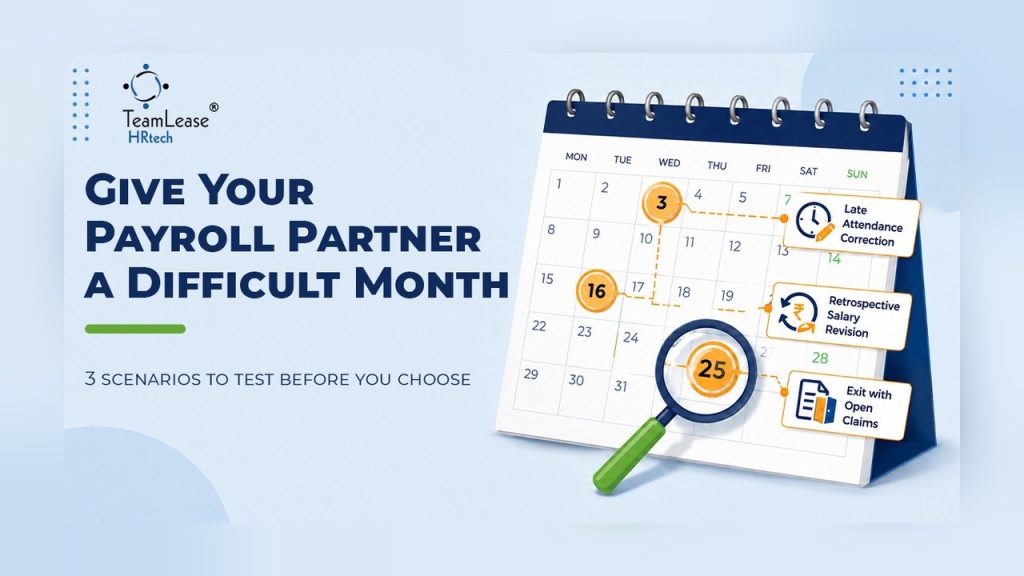
For HR and finance leaders evaluating managed payroll, these situations offer a practical way to examine the service and the provider’s capabilities before appointing a partner. When you ask a provider to work through a difficult month drawn from your own business, its response should reveal the information it needs, the responsibilities it takes on, and the controls that support its decisions.
When the input changes after cut-off
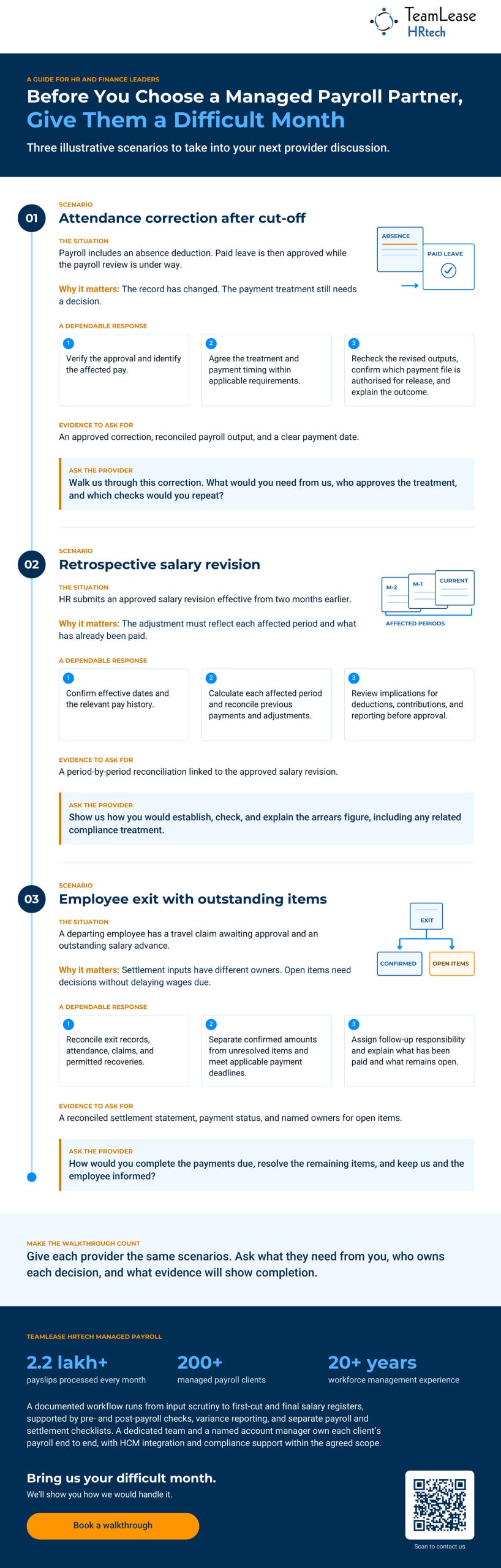
Let’s start with the attendance correction. The initial payroll calculation includes a deduction for an absence that has now been approved as paid leave. The source record has changed, but the payroll review is already under way.
The provider first needs to establish what changed and whether the amendment has the required approval. It then needs to identify the affected calculation and the stage the payroll run has reached. Updating an input before review, replacing an approved register, and correcting a payment already released each require a different response.
Connected HCM records can make the revised attendance entry and approval available. The payroll team still needs to decide how to incorporate the correction, obtain authorisation, and repeat the relevant checks. Where an existing payment file is replaced, there must also be clarity about which version can be released.
Timing needs equal attention. The response could involve correcting the current run, arranging a separately authorised payment, or carrying the adjustment into the next cycle, depending on the processing stage and applicable payment requirements. The employee should receive a clear explanation of the treatment and expected payment date. A correction received after cut-off should follow an agreed exception process, with a clear owner.
A useful evaluation question is how the provider would take this approved correction through to payment. Listen for the decision points and the checks it would repeat, as well as what your team would need to authorise.
When the revision reaches into earlier months
During the same cycle, HR submits a retrospective salary revision. The new amount is clear. Establishing what is owed requires the team to work back through the periods it affects.
An effective date part-way through a month may require a proportionate adjustment. Unpaid leave or an earlier correction may also affect the calculation. The team needs the approved revision, the relevant pay history, and a record of what has already been paid. Simply applying the difference between two monthly salaries across the elapsed period could miss those details.
This is where the quality of the employee record matters. A current salary field cannot, by itself, explain a historical adjustment. The provider needs to establish the applicable rates and dates, calculate each affected period, and reconcile the result against previous payments so that an amount is neither missed nor counted twice.
The review should also assess whether the adjustment changes deductions, employer contributions, or related reporting. Where payroll and compliance responsibilities sit with different teams, the handover needs a named owner. The applicable treatment should be established before the adjusted outputs are approved.
Ask the provider to demonstrate how it would explain the arrears figure to finance and the employee. A period-by-period reconciliation, linked to the approved revision, gives both a way to understand the result. It also shows whether the service can preserve the history behind a change while keeping current records accurate.
When an exit leaves work unfinished
A departing employee introduces a different complication. The exit date is recorded, but the travel claim is still with a manager, and finance needs to confirm the remaining advance balance. Payroll cannot establish every settlement input from the employee’s last working day alone.
The team needs to bring together the confirmed exit date, final attendance, relevant leave balances, approved claims, and any permitted recoveries. It must also check what the regular payroll has already included, so that salary or an adjustment does not appear twice.
An unresolved claim needs an owner and a route to decision. It should not become an indefinite hold on wages due. The treatment of each payment and recovery needs to meet applicable requirements, with payment deadlines distinguished from the organisation’s internal clearance timetable.
HCM can supply the exit record and clearance status; finance may need to validate balances; payroll and compliance specialists assess the relevant treatment. The service arrangement should make clear who brings those inputs together and follows up when something is missing. The employee also needs an understandable account of what has been paid and what remains open.
In the evaluation, ask the provider to explain how it separates confirmed amounts from unresolved items and tracks each through to completion. This makes the scope of its responsibility visible before your team has to coordinate a live settlement.
Bring the difficult month into the evaluation
These walkthroughs can help buyers compare proposals that use similar language. Give each provider the same anonymised scenarios and ask for the process, client responsibilities, and examples of supporting records. Useful evidence might include an approval trail, an arrears reconciliation, or a reconciled settlement statement.
Pay attention to the questions the provider asks. Identifying a missing approval, an uncertain effective date, or an unresolved balance shows that it understands the conditions needed to proceed. Establish where your team will retain authority and who will coordinate the remaining work.
TeamLease HRtech’s managed payroll service follows a documented monthly workflow, from input scrutiny and pre-payroll checks to first-cut and final salary registers. Post-payroll checks, variance reporting, and separate payroll and settlement checklists support each review. A dedicated team and a named account manager own each client’s payroll end to end, so exceptions have a clear owner and a single escalation path.
For organisations using TeamLease HCM, approved leave syncs directly to payroll and exit clearances feed into the full and final settlement. TeamLease’s compliance team manages the related statutory obligations within the agreed scope. Backed by TeamLease Group’s 20+ years of workforce management experience in India, the managed payroll service processes more than 2.2 lakh payslips every month for over 200 clients.
A difficult month gives the evaluation substance. Before choosing a partner, understand how it will reach a decision, act on it with the right approvals, and show that the resulting work is complete.