
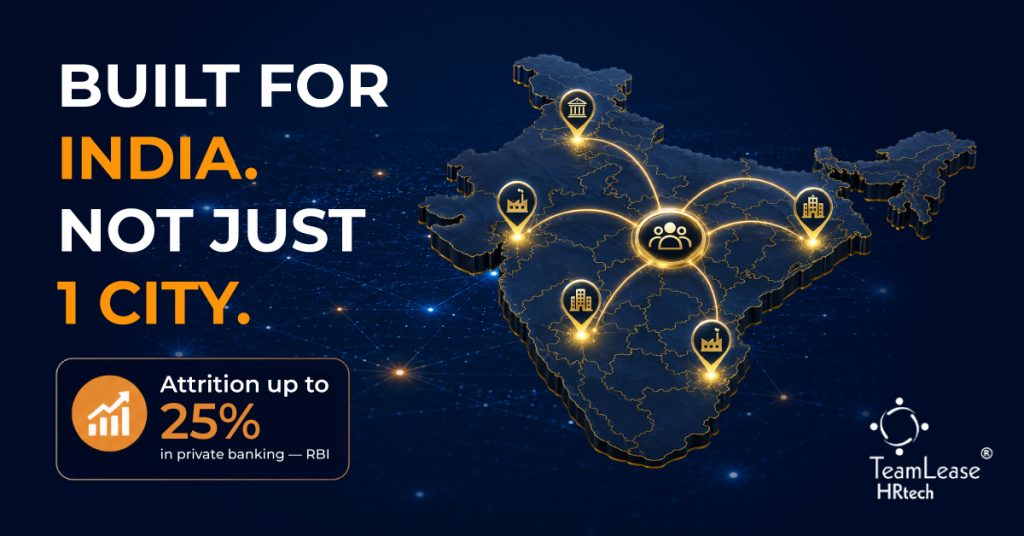
Most HR platforms were designed to manage people. Very few were designed to manage people across many cities, multiple state jurisdictions, and constantly shifting compliance obligations, which is the actual reality for most large financial services enterprises operating in India today.
Choosing the right HCM for distributed workforce operations is one of the most consequential decisions an HR or Finance leader can make. A bank with 150 branches across six states. An insurance company with hundreds of locations across multiple states, running on a distributed field force of employees and agents alike. An NBFC with branches spread across states, relying on a mixed workforce of contractual staff and full-time employees. None of these are edge cases. This is what a large, distributed financial services workforce actually looks like. And it is precisely the ability to effectively handle these kinds of scenarios that separates a genuinely capable HCM platform from one that merely functions well in a demo, in front of a single HR team, in a single city.
Most enterprise HR platforms weren’t designed with this specific reality in mind. They assume a workforce that’s broadly homogeneous, based in one or two locations, operating under one reasonably stable set of rules—an assumption that doesn’t survive contact with how large banks, insurers, and NBFCs actually operate.
One Country, Many Rulebooks
The obvious challenge of a distributed workforce is physical—people working from different offices, plants, or branches, without a single HR team down the corridor to handle things in person. But the harder problem is regulatory, not physical. India’s compliance landscape does not treat every location the same way. Professional Tax rates and slabs vary by state. Shop and Establishment Act obligations differ by jurisdiction. Labour law interpretation is not uniform across state labour departments. A platform that treats compliance as a single, national configuration, rather than a state-by-state one, will quietly start creating regulatory problems the moment an organisation operates in more than a couple of states.
The hardest part of a distributed financial services workforce isn’t managing many locations. It’s that every one of them plays by slightly different rules.
This is not a theoretical risk. Every additional location a company opens adds another jurisdiction’s rules to track, another local nuance to get right, and another point at which a generic, one-size-fits-all system falls behind. The numbers bear this out. Private banks have seen attrition run as high as 25 percent annually, according to the RBI. NBFCs have reported annual attrition of around 77 percent, according to TeamLease Services research, and IRDAI’s own data shows life insurers terminated nearly 7 lakh agents in a single year. A workforce turning over this quickly across many locations needs onboarding, attendance, and compliance processes that hold up under constant change, not just at a single point in time when the system was first configured.
There’s an operational dimension that compounds the regulatory one. A distributed workforce doesn’t just need rules applied correctly in each location. It needs someone able to see across all of them at once. Consider a microfinance institution with field officers reaching hundreds of villages across a dozen states. A CHRO reviewing attendance patterns, leave trends, or compliance status one location at a time, through separate local reports, is working with a fraction of the picture at any given moment—and the more dispersed the operation, the smaller that fraction gets. What’s needed is a system that can show the whole workforce, across every location, in one place, without waiting for someone to compile it manually.
The India Imperative
A platform genuinely built for this reality needs at least three things most generic HRMS platforms weren’t designed with in mind. First, attendance and leave management that can handle real local nuances—different shift timings, state and regional holidays, multiple shift patterns across sites—rather than assuming a single office running a nine-to-six workday. Second, compliance that is structured around India’s actual regulatory geography—PF, ESIC, Professional Tax, TDS, and the evolving Labour Codes—tracked and updated at the state level, not bolted on as an afterthought to a platform built for a different market. Third, an onboarding and exit process that can absorb constant movement without becoming a bottleneck, since a distributed, high-churn workforce doesn’t onboard or offboard people occasionally, it does so continuously, every week, across multiple locations at once.
A platform that treats compliance as one national setting will quietly fall behind the moment a business operates in more than a couple of states.
The Scale Toll
It’s tempting to assume that a larger organisation, with more resources, can simply absorb this complexity by throwing people at it—a compliance officer per region, a larger HR operations team, more manual reconciliation with spreadsheets. In practice, the opposite tends to happen. The more locations and the more employees a system has to serve, the more expensive and fragile it becomes to manage complexity manually. A process that works with three branches becomes unmanageable at thirty, not because the individual tasks change, but because the coordination burden multiplies faster than headcount does.
This is exactly why the “any HRMS will do” assumption breaks down precisely at the scale where it matters most—the point at which an organisation has grown enough to need real workforce infrastructure, not just a system of record that happens to hold employee data.
Many Rules, One Solution
As a purpose-built HCM for distributed workforce management, TeamLease HCM was built specifically for this reality, rather than adapted for it after the fact. Backed by TeamLease Group’s more than 20 years of India workforce management experience, the platform brings core HR, self-service onboarding, attendance and leave, performance, helpdesk and ticketing, and structured exit management together on a single system, proven at the scale of 1,000 to 25,000-plus employees that large, distributed Indian financial services firms actually operate at.
TeamLease’s compliance team and platform handle this the way India’s regulatory reality demands—tracked and updated state by state across PF, ESIC, Professional Tax, TDS, and the Labour Codes, rather than treated as a single national setting applied uniformly. Payroll can be run as a fully managed service—with a dedicated account team and defined SLAs—so organisations aren’t left carrying the operational risk of running payroll themselves across a complex, distributed workforce.
For an HR or Finance leader evaluating HCM platforms, the right question isn’t whether a vendor’s system works in principle. It’s whether it was built for the specific complexity of a distributed financial services workforce, or simply looks like it can handle that complexity in a demo. That gap rarely shows up during a sales demo. It shows up much later, once the organisation has grown well past the size it was built for, when the system that looked adequate at a handful of branches is quietly being propped up by a team leaning on spreadsheets and workarounds, and working harder than they should have to.
