
There is a moment in every growing organization when payroll stops being a process and becomes a problem.
It does not begin with a system failure or a compliance notice. It begins far more quietly. With an employee who opens their pay slip and realizes that something is not quite right. A missing allowance. An incorrect deduction. A delayed payment. What follows is predictable. A query is raised, an escalation could be made, and eventually a correction is made.
On the surface, it seems like a simple numbers issue. But in reality, something far more significant has happened.
Payroll is not just a transaction. It is the most visible proof of an organization’s reliability. When it works well, no one really notices it. But when it fails, it changes how people see the system. By extension, it changes how the organization is perceived.
That is why payroll errors are never just accounting mistakes. Consistent errors can cause serious trust issues among the workforce.
The Complexity Behind the Error
At a smaller scale, payroll is often manageable through a combination of systems, spreadsheets, and manual oversight. This works up to a certain point. But as an organization grows, something fundamental changes. With growth comes higher volumes, and critically, greater complexity.
More locations. More shift patterns. More policy variants. More exceptions. What was once a relatively straightforward process, becomes a system of interdependent rules and data flows across different systems.
This is where traditional controls begin to weaken. Manual checks and end-cycle corrections are no longer sufficient. These errors do not arise because teams are careless. They creep in because the system was never designed to deal with the complexities that come with rapid growth.
This challenge is widely recognized. Organizations struggle with payroll complexity that is driven by fragmented systems and inconsistent processes resulting in inefficiencies and reduced control.
In India, the problem is compounded by regulatory fragmentation. State specific labor laws, evolving wage codes, and diverse workforce models make payroll highly complex.
When Systems Fragment, Errors Multiply
If complexity is the context, fragmentation turns out to be the trigger.
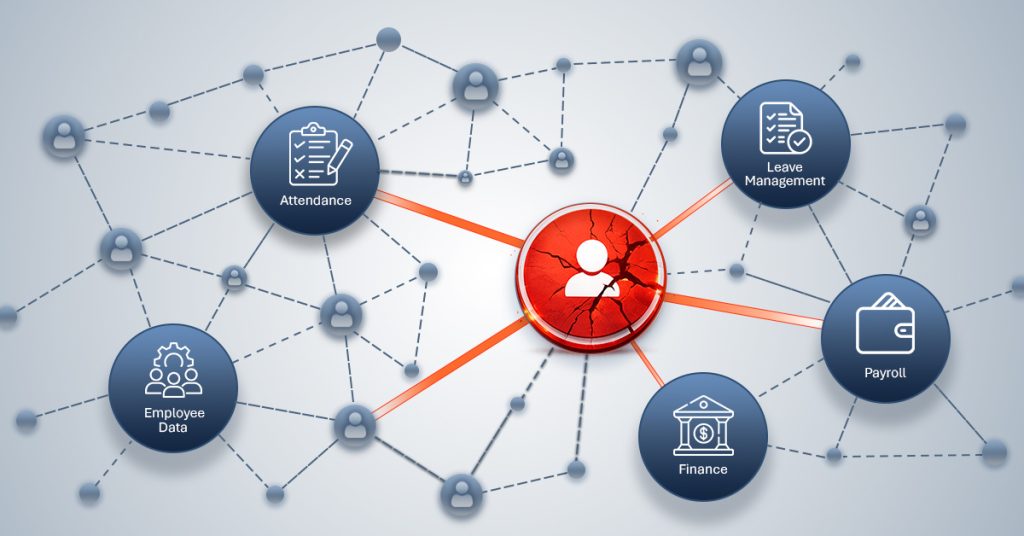
In many organizations, payroll inputs exist in separate systems. Attendance, leave, reimbursements, and employee data reside in systems that do not connect directly with each other. Manual corrections are made in batches and data is re-entered across tools.
A correction made in one system does not reach the next in time. Small inconsistencies accumulate over time. By the time payroll is processed, what should have been structured inputs turn into a series of corrections and adjustments.
This fragmentation creates deeper issues like broken workflows, shadow reconciliation, and inconsistent reporting. This is compounded further especially when there is no single source of truth for employee data.
These fragmented HR systems significantly increase operational inefficiencies and reduce confidence in business-critical data like payroll. When this point arrives, payroll closure becomes less about processing and more about reconciliation.
The First Cost: Employee Trust Erosion
For employees, payroll is not a backend function. It is a monthly assurance. It defines financial stability. It reflects fairness and it signals whether the organization delivers on its commitments towards employees. When payroll errors occur, they introduce immediate financial uncertainty for the employee. This in turn creates a massive lack of trust and a significant drop in job satisfaction.
This is not purely anecdotal evidence. There is a statistically significant correlation between transparent, accurate payroll processing and overall employee job satisfaction. When an organization fails at this basic operational requirement, the consequences can escalate rapidly.
Payroll mistakes are often viewed by staff as a direct reflection of workplace respect. Studies show that over 50% of employees think that repeated payroll errors would cause them to actively leave the company, while over 20% lose trust in their employer after a single error. This failure directly damages productivity.
So what begins as a discrepancy, quickly morphs into distrust. And when operational discrepancies repeat, distrust becomes the new expectation.
The Second Cost: HR Credibility Decline
The ripple does not stop with employees.
As payroll issues increase, HR teams are pulled into a never-ending cycle of resolution. Teams end up answering queries, correcting records and validating data. Time that ought to be spent on strategic initiatives, is consumed by operational recovery.
Disconnected data makes this worse. When employee records, reporting lines, or entitlements are inconsistent and sit in unintegrated silos, workflows break, approvals slow down and errors begin to multiply.
Over time, HR’s role shifts from strategic enabler to reactive problem-solver.
This can have some serious cost implications for organizations and can have long term implications. During an average work week, HR practitioners spend approximately 19 hours resolving employee disputes and over 16 hours managing routine administrative tasks. This leaves just nine hours per week for actual strategic work.
HR functions that are heavily burdened with operational inefficiencies are far less likely to be perceived as strategic partners by leadership. The impact might be subtle but it is significant nonetheless. The issue now transforms from just payroll to the credibility of the entire HR function.
The Third Cost: Finance and Compliance Risk
Payroll is not just an HR process. It is a financial control system. Errors in payroll affect reporting accuracy, delay financial closure, and create audit risks. In regulated environments, they can also lead to statutory penalties.
In India, this risk is amplified. Payroll must comply with multiple laws that often vary by state. These include Employees Provident Fund (EPF), Employee State Insurance (ESI), Professional Tax and minimum wage requirements.
Managing payroll compliance across jurisdictions is one of the most complex operational challenges for enterprises when they scale, with inaccuracies increasing exposure to penalties and regulatory scrutiny.
At scale, payroll errors are no longer restricted to being process issues. They are financial risks that can make it to the balance sheet.
The Hidden Risk: Operational Fragility
Behind all of these issues lies a deeper problem, which is fragility. Many payroll systems rely heavily on individuals. Knowledge of pay structures, compliance rules, and process nuances often reside with a handful of key people. When they exit or are unavailable, continuity is disrupted.
This creates a single point of failure leaving organizations susceptible to sudden systemic failures and major bottlenecks.
Internal payroll systems also tend to be under-prioritized by management. They are seen as support functions rather than strategic systems. Investment lags, complexity increases with scale, and reliability eventually declines.
When organizations underestimate or ignore payroll risk, operational disruptions expose systemic weaknesses. Everything snowballs from there.
From Payroll Error to Enterprise Risk
In isolation, a payroll error seems manageable. But at scale, a pattern emerges and remains consistent:
Errors → Employee dissatisfaction → HR workload → Finance reconciliation → Leadership concern
Every step means friction. And every escalation reduces confidence in the system.
In manufacturing, shift mismatches can lead to disputes. In healthcare, incorrect differential pay can raise compliance issues. In BFSI, errors can escalate into audit risks eventually.
Individually, these could be dismissed as isolated incidents. They often are, to begin with. But collectively, they become patterns. And patterns are what senior leadership responds to.
What Fixing Payroll Really Requires
Solving payroll errors is not about working harder. It is about redesigning the system.
Three elements become critical:
- Integration: Data must flow seamlessly from attendance, leave, and employee systems into payroll
- Rules: Policies must be codified and applied consistently, not interpreted manually
- Visibility: Exceptions must be identified and addressed before payroll closure
When these elements are in place, payroll shifts from reactive correction to proactive control. This is not just incremental improvement. It is structural change.
Managed Payroll as a Strategic Control Layer
In this context, managed payroll is often misunderstood. It is not just plain outsourcing. In reality it is proactive risk management.
Modern managed payroll models combine domain expertise, compliance capability, and integrated technology to ensure consistency, accuracy, and audit-readiness at scale. This ensures consistency and readiness at scale.
They address the root causes of payroll failure:
- Fragmentation is solved through unified systems
- Skill gaps are addressed via specialized expertise
- Compliance risk is minimized through standardized processes and automated workflows where possible
- Operational fragility eliminated by building continuity and scale
This shift is reflected in broader industry trends. High performance organizations are increasingly adopting managed payroll models to enforce process standardization, improve accuracy, reduce risk, and strengthen overall governance.
A CXO Lens on Payroll
At the leadership level, the question is no longer whether payroll works.
It’s about how reliably it works.
- For the CFO: How predictable is payroll close?
- For the CHRO: How often does payroll drive employee dissatisfaction?
- For the CEO: Does payroll reinforce trust—or erode it?
These are not operational questions. They are strategic in nature.
Payroll as Trust Infrastructure
At its core, payroll is not just a process. It is infrastructure. It stays invisible when it works but is highly visible when it fails. It must be reliable and scalable.
Because when payroll fails, it does not just create errors. It creates doubt. And organizations do not lose trust because mistakes happen. They lose it when mistakes become expected.
In modern enterprises, payroll is no longer a backend function. It is proof of operational integrity and robustness.
