However, this reliance can create a dangerous false sense of security.
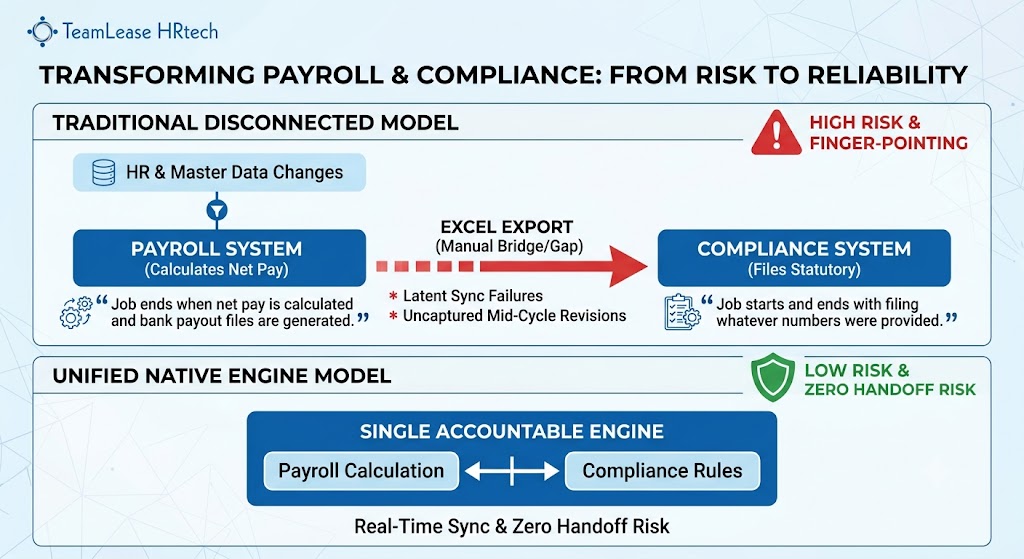
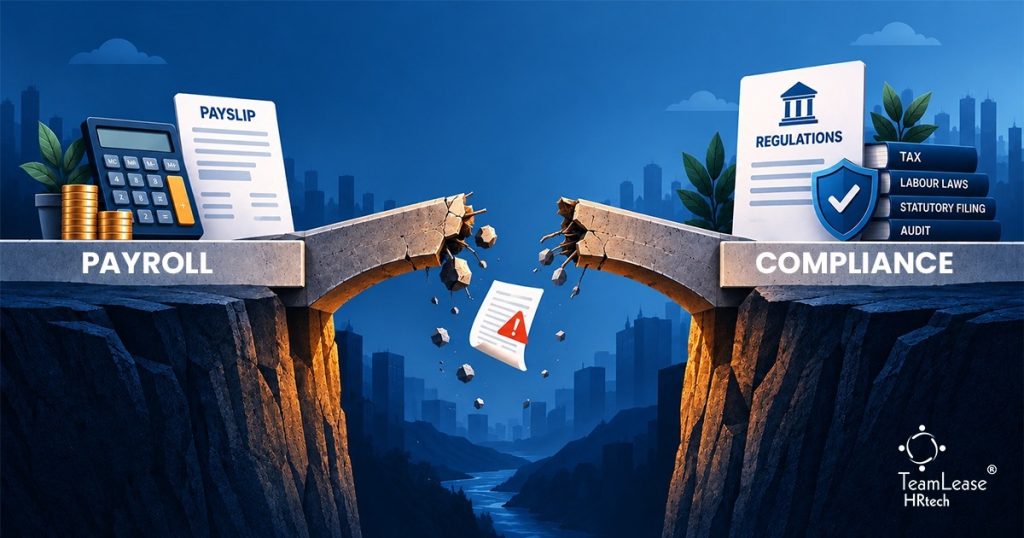
In most organisations, payroll and statutory compliance are frequently treated as two distinct functions. They are either split internally between HR Operations and Finance or divided externally across two niche outsourcing vendors. This structural division relies on a manual bridge known as the “handoff.”
Payroll calculates salary components, computes net compensation, and generates gross-to-net registers. Compliance takes the reported output data to file statutory returns like Employees Provident Fund (EPF), Employees State Insurance (ESI), Professional Tax (PT) and Tax Deducted at Source (TDS), among others.
The handoff between these two disciplines works smoothly — typically when numbers remain fixed and static. But modern enterprises do not operate in a static environment. Salary restructuring, mid-month exits, or retroactive revisions are frequent occurrences in modern organisations. These moments where payroll changes mid-cycle can expose how fragile this bridge really is.
The Invisible Fault Line in Modern HR Operations
The operational separation of payroll and compliance stems from an outdated view of human capital management (HCM). In this traditional mindset, payroll is viewed as a financial calculation task, while compliance is seen as an administrative filing duty.
When these two domains are owned by separate entities, the connection between them relies heavily on static monthly exports. Typically, these take the form of CSV or Excel files generated after payroll freeze. The core flaw of this setup is that neither party is incentivized or structured to monitor the integrity of the data in transit.
Data fragmentation across disjointed systems remains one of the primary drivers of organisational compliance risk. When changes occur after initial processing, the manual bridge breaks down, and errors often remain hidden until statutory audits expose them years later.
Anatomy of a Handoff Failure: The Mid-Cycle Disconnect
To understand how handoff failures happen, we must look at how mid-cycle adjustments ripple through separate operational workflows.
Scenario A: Mid-Month Salary Restructuring and Retroactive Revisions
Consider a mid-month salary restructuring or a retroactive pay revision.
- The Trigger: An executive’s compensation package is restructured mid-cycle, altering their basic wage component and statutory allowance allocations to ensure alignment with statutory definitions.
- The Handoff Break: The payroll engine processes the retroactive arrears and generates updated net payouts. However, because statutory returns depend on static monthly reports, the compliance vendor files the Electronic Challan-cum-Return (ECR) based on initial baseline figures.
- The Result: A clear discrepancy forms between the actual wages disbursed in the payroll register and the wages reported to statutory bodies like the Employees’ Provident Fund Organisation (EPFO).
Scenario B: Full & Final (F&F) Settlements and Employee Exits
An equally common failure occurs during employee exits.
- The Trigger: An employee leaves an organisation mid-month with unadjusted notice pay, leave encashments, and pending statutory recoveries.
- The Handoff Break: The exit date is recorded in the core HRMS and processed within the payroll system’s Full & Final settlement module. However, because the compliance team receives data only during the regular monthly filing cycle, the employee’s status on government portals (such as ESIC or EPFO) remains active past their true exit date.
- The Result: The organisation risks filing non-compliant contribution calculations or missing statutory exit-reporting deadlines entirely.
Statutory authorities do not evaluate process intentions. They evaluate outcomes. Statutory non-compliance in India carries immediate penalties ranging from interest charges of 1.5% per month on delayed TDS remittances to statutory damages reaching up to 25% on unpaid EPF contributions.
The Vendor Blindspot: Why Point Solutions Won’t Fix a Structural Flaw
When statutory discrepancies surface, enterprises often discover an uncomfortable truth. Point solution vendors often disclaim responsibility for handoff failures.
- Payroll Vendors maintain that their contractual obligations end once the Gross-to-Net register is verified and the bank payout file is delivered. They do not validate whether the wage components map correctly to evolving statutory filing rules.
- Compliance Vendors argue that their scope begins and ends with submitting filings based on the raw datasets provided to them. They do not audit whether the underlying payroll calculations reflect recent policy updates or mid-cycle adjustments.
Neither can be faulted. But this does create a structural blind spot where both vendors execute their individual tasks, yet the overall process remains vulnerable and non-compliant. When regulatory audit notices arrive, both sides point to the other, leaving internal HR and Finance leaders to manage the financial, legal, and reputational fallout.
The Strategic Imperative: Moving to a Single Accountable Platform
Resolving the handoff vulnerability requires moving away from static file transfers between separate systems. Instead, organisations must adopt a unified HCM architecture where payroll processing and statutory compliance share a single, native calculation engine.
Modern HR transformations depend on consolidating disparate HR tech stacks into unified platforms to eliminate sync failures and reduce operating risks.

A unified architecture transforms statutory management through three primary capabilities:
- Native Statutory Rule Engines: Rather than treating compliance as a post-payroll export, calculation rules for PF, ESI, PT, LWF, and Income Tax are embedded directly into the payroll engine. Any change to a salary component, work location, or employee status automatically updates statutory deductions in real time.
- Single-Point Accountability: By managing payroll and compliance through one unified partner, organisations eliminate multi-vendor friction. One partner remains accountable for calculation accuracy, data integrity, and statutory filings.
- End-to-End Audit Trail: A unified system maintains a continuous data trail. Internal teams can trace any output. Be it a final bank transfer file or an ECR challan, it can be traced back to the original employee record update.
From Fragmented Operations to Continuous Regulatory Assurance
Separating payroll calculation from statutory compliance is not an effective division of labor. In fact, it is an unnecessary operational risk. As regulatory frameworks continue to evolve in India, and government enforcement becomes more digital, static handoffs are no longer viable for modern enterprises. It becomes an operational hinderance.
True HR digital transformation requires enterprise leaders to look beyond simple processing speed and evaluate the structural integrity of their operational workflows.
Diagnostic Checklist for HR and Finance Leaders:
- Does your compliance team wait for an Excel export from your payroll team before preparing statutory returns?
- If a salary revision is approved post-payroll freeze, does your compliance engine automatically update statutory liabilities, or does it require manual intervention?
- In the event of an EPFO or Income Tax notice, do you have a single partner accountable for the entire pipeline, or will you end up mediating between separate vendors?
If the organisation’s current architecture relies on manual file transfers, the organisation remains exposed to systemic regulatory risk. Moving to a single accountable partner on a unified system ensures that payroll and compliance operate as one continuous, automated workflow and can eliminate handoff failures before they occur.