
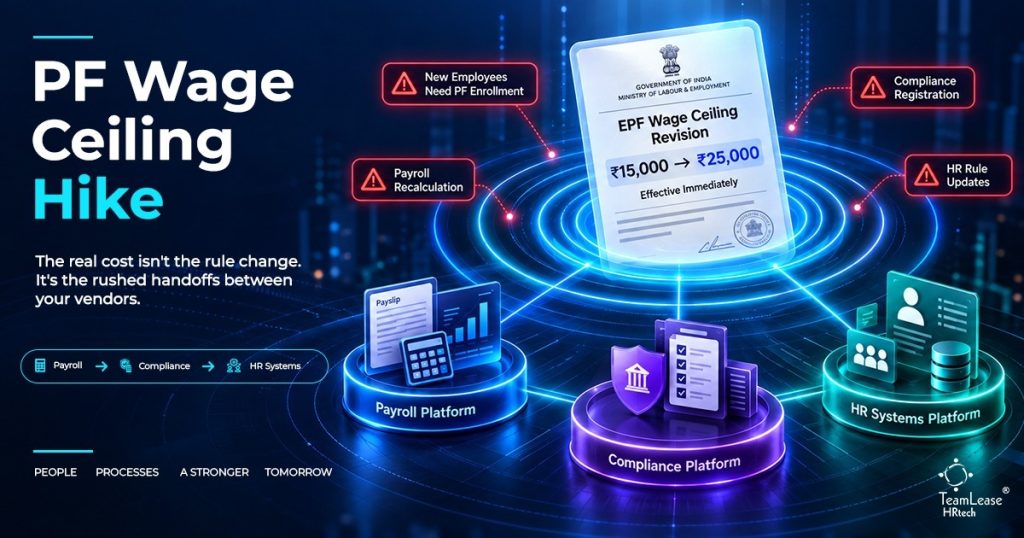
On September 17, 2026, a single Cabinet decision raised the EPF wage ceiling from ₹15,000 to ₹25,000—and gave companies almost no time to catch up. What comes next is a clean illustration of something that happens every time a number like this moves in India: it doesn’t stay in one system, and it rarely gives anyone much notice.
On September 17, the revised PF wage ceiling took effect—a single day after the Union Cabinet approved it, and with the Employees’ Provident Fund Organisation’s own implementation circular still unpublished days later. Roughly 51 lakh employees earning between ₹15,000 and ₹25,000 a month, previously free to opt out of provident fund coverage entirely, became mandatorily covered overnight. While most discussions have been about what it costs—a few hundred rupees more per employee, per month, multiplied across a workforce—there’s a real hidden problem that no one’s talking about.
That hidden problem is what a change like this actually requires, mechanically, inside a company. It doesn’t land as one task. It lands as three, in three different systems, usually owned by three different vendors.
One change, three systems
In payroll, every affected employee’s contribution base needs recalculating from this cycle onwards, and every employee who moved from “excluded” to “mandatory” needs to be freshly onboarded into the scheme—UAN, KYC, nomination, the lot—not simply re-rated. Statutory filings need to reflect the new ceiling from the very first affected pay cycle.
And because September 17 falls in the middle of a payroll month, companies have had to decide, without an official answer, whether to apply the new ceiling on a pro rata basis for the part of September after the 17th, or hold the old figure for the whole month and switch only from October. The last time this ceiling moved, in 2014, it happened to land on the first of a month, so this particular problem never came up. This time, nobody has that luxury.
In compliance, that same population of newly covered employees needs fresh registrations and updated statutory registers. And because principal-employer liability extends to contractor and vendor workforces, not just direct payroll, the same exercise has to be repeated for anyone a company brings in through a staffing or contracting arrangement, whether or not that arrangement’s own payroll has caught up yet.
In HR systems, it shows up more quietly: an eligibility flag on the employee master record that was set against ₹15,000 needs updating to ₹25,000, and any organisation-configured rule that still references the old number—in whatever system that holds the configuration—needs to be found and changed before it quietly keeps running yesterday’s logic.
Three systems. One trigger. And not even the regulator has finished catching up with itself.
No time to get any of it right
What makes this harder than it needs to be isn’t the number of systems involved—it’s how little time there was to touch any of them. This decision went from Cabinet approval to effective the following day.
There was no phased rollout, no advance notice period, no window to update three systems in an orderly sequence and test them before the new rule started applying to real payslips. Companies were, in effect, asked to have already made three simultaneous changes by the time most of them had even read the news.
That isn’t a one-off feature of this particular change. It’s closer to the normal pace of regulatory change in India. The Code on Wages’ new definition of “wages”—which pulls allowances above 50 per cent of total pay back into the base used for PF, gratuity, and bonus—forced a comparable scramble across the same three systems less than a year earlier, on a similarly compressed timeline once it actually took effect.
The next revision, whether it’s an ESI ceiling, a state-specific professional tax change, or the next Labour Code milestone still working through implementation, will arrive on the government’s schedule, not any company’s.
Where the coordination actually lives
None of this is really a story about payroll, or about compliance, or about HR software. It’s a story about the handoffs between them—and about what happens to those handoffs specifically when there’s no time to be careful. Three vendors means three interpretations of the same rule, three separate timelines, and three teams each confident their own piece is handled, with nobody accountable for what happens between them.
That’s exactly where an employee gets correctly onboarded in payroll but never flagged in the HR system, or where a compliance filing reflects the new threshold while the underlying payroll run hasn’t caught up yet. Not through anyone’s carelessness—coordinating three external relationships under a crunched deadline is a genuinely hard problem, and hard problems are where things get missed.
The alternative isn’t better software in any one of the three systems. It’s not needing to coordinate with three vendors in the first place.
TeamLease HRtech runs HCM, managed payroll, and compliance as one accountable partnership rather than three separately managed relationships. When a threshold like this changes, the update happens once—inside the same team that is also running payroll for those employees and reporting that same population to the regulator—rather than three times, at three different speeds, across three companies who each have to be individually told that something changed.
A real-time compliance dashboard gives one current view of status across every entity, rather than three vendors each working from their own limited picture. On the payroll side, statutory deduction rate mapping and pre-payroll checks are built to catch a threshold change at the point of calculation, not after a return has already gone out the door with the old number still on it. And because compliance sits inside that same structure rather than as a separately contracted service, principal-employer exposure on contractor and vendor workforces gets tracked from the same place, instead of being left for a company to chase down on its own.
With more than 20 years of India-specific workforce management experience across 450-plus clients, TeamLease HRtech is built to be exactly that accountable partner—absorbing the coordination itself instead of leaving a company to manage it alone.
The next regulatory change is already somewhere in the pipeline. The only real question is whether it finds three vendors racing to catch up, or one partner who was already watching for it.
