
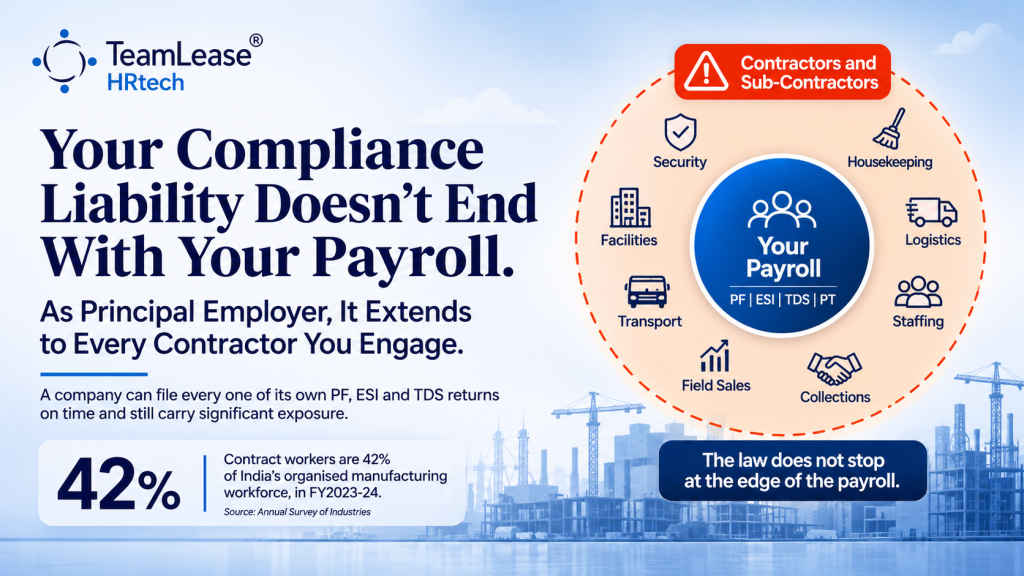
Principal employer liability means a company can file every one of its own PF, ESI and TDS returns on time and still carry significant exposure. Indian labour law holds the principal employer answerable for the wages, contributions and welfare obligations its contractors fail to meet—and as contract workforces spread across sites, that exposure tends to grow without showing up in any report.
Ask most Finance or HR leaders how their compliance is doing, and the answer usually comes back in terms of their own payroll: PF and ESI deposited on time, PT and TDS filed, registers in order. That is the part of compliance they can see, and the part they control.
It is no longer the whole picture. Contract workers made up 42% of India’s organised manufacturing workforce in FY2023-24, according to Annual Survey of Industries data—the highest share since 1997-98. GCCs rely on contracted staff for facilities, security, transport and support functions. Banks and NBFCs run collections and field sales through outsourced agencies. In many organisations, a large share of the people working on the premises, or for the business, are not on its rolls at all.
The law does not stop at the edge of the payroll. A business on whose premises, or for whose work, contract labour is deployed is the principal employer, and a set of obligations follows the work rather than the payslip. Since 21 November 2025, these rules have sat in the Occupational Safety, Health and Working Conditions Code, which replaced the Contract Labour (Regulation and Abolition) Act, 1970, alongside the Code on Social Security. The legal home has changed. The principle has not.
For finance and HR leaders, principal employer liability is easy to miss because it never appears in the company’s own payroll or filing reports.
What Principal Employer Liability Actually Covers
The contractor remains primarily responsible for paying its workers and remitting their dues. But the law treats the principal employer as the backstop. If a contractor fails to pay wages, or pays less than it owes, the principal employer must make up the shortfall and recover it from the contractor afterwards. The Code on Social Security works the same way for contributions: the principal employer can be required to pay the PF and ESI contributions due for workers engaged through a contractor, including the employee’s share, and then recover the amount by deducting it from contract payments or as a debt. None of this requires the principal employer to have done anything wrong itself. The exposure arises simply from the contractor’s default.
The obligations go beyond money. The principal employer must ensure contract workers have access to prescribed welfare facilities—drinking water, washing facilities, first aid, and canteens or crèches where workforce thresholds apply. Contractors engaging 50 or more contract workers need a licence, and engaging a contractor who should be licensed but is not is treated as a contravention by the principal employer itself. Records and annual returns covering contractor-wise wages and contributions add a documentation trail the principal employer is expected to maintain.
Many organisations believe a well-drafted service agreement moves this risk to the contractor. It does not. An indemnity clause gives the principal employer a route to recover money after a default. It does not change who owes the workers, or who answers to an inspector.
Where It Most Commonly Goes Wrong
The failures are rarely dramatic. A contractor that started with 30 people on a site grows past the licensing threshold as the operation expands, and nobody checks whether a licence was obtained. A licence that was valid at onboarding lapses mid-engagement because the renewal date lives in the contractor’s files, not the principal employer’s. PF and ESI contributions go undeposited for months, and the gap surfaces only when an inspection asks for challans. Work gets passed down to a sub-contractor, and the principal employer no longer knows who actually employs the people on its site.
The same pattern shows up well beyond the factory floor. A collections agency working for an NBFC may rely on smaller sub-agencies across districts. A facilities vendor serving a GCC campus may rotate staff between clients. In both cases, the principal employer’s exposure depends on records it has never seen.
Behind almost every one of these is the same habit: relying on the contractor’s own declaration instead of documentary evidence. A self-certified compliance statement signed at onboarding says very little about what was deposited last month.
Why the Exposure Grows as You Scale
A single site with two or three contractors is manageable. A business running plants, offices or branches across several states, each with its own housekeeping, security, logistics and staffing vendors, is a different matter. Every new location brings new contractors, and often a different state’s rules and inspection practices.
Ownership tends to split along functional lines. Procurement negotiates and holds the contract. The site or facility head manages the people on the ground. HR or Finance owns compliance for the company’s own payroll. Each function sees one piece, and nobody sees the whole. The result is exposure that accumulates across sites without appearing in any single report—until a notice, an inspection or a wage dispute brings it into view.
This is where the way compliance is scoped starts to matter. When compliance is run as an extension of payroll, its reach naturally ends at the company’s own rolls, and contractor compliance falls outside that boundary by design. It needs its own scope, a clear owner, and an evidence trail that does not depend on the contractor’s word.
Bringing Contractors Inside the Compliance Perimeter
In practice, good oversight comes down to a few disciplines. Contractor licences are verified before workers are deployed, and tracked for renewal rather than checked once. Proof of PF and ESI remittance—challans, not declarations—is collected every month rather than assembled at audit time. Contractor-wise records are maintained by the principal employer, not borrowed from the contractor when an inspector asks. And there is one view of contractor compliance across every site, so exposure is visible before anyone else finds it.
This is the discipline TeamLease HRtech brings to compliance. TeamLease’s compliance team and platform extend principal-employer oversight to contractors and vendors, with documented compliance checks running alongside the organisation’s own statutory filings. A real-time compliance dashboard gives a single view of status across entities, and dedicated compliance experts with a nationwide, on-ground presence work integrated with payroll, so contractor gaps surface in the organisation’s own records rather than in an inspector’s. Backed by 20+ years of experience and 450+ clients, TeamLease HRtech helps organisations treat their contract workforce as part of their compliance perimeter, not an exception to it.
