
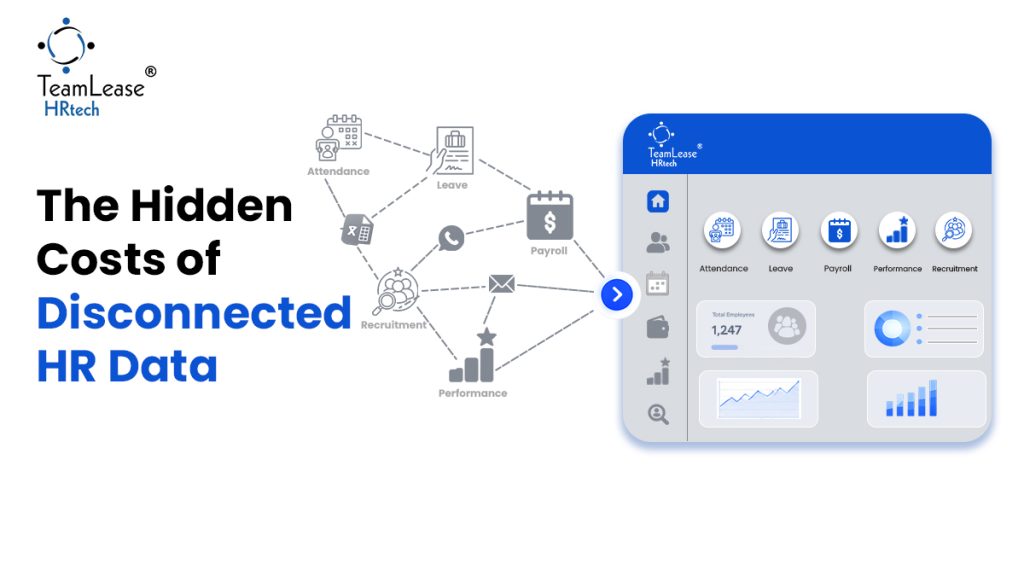
Most organisations don’t notice their HR data is fragmented until a decision is made on numbers that were already a week out of date. When attendance sits in one system, leave records reside in WhatsApp, and performance reviews live in email threads and spreadsheets, the cost doesn’t appear as a line item in some report. It shows up daily in regular work.
Ask an HR leader whether their systems talk to each other, and the answer is rarely a simple yes. A recruitment tracker feeds candidate data into onboarding. Attendance is captured on a biometric device or a mobile app that may or may not sync cleanly with payroll. Employees communicate leave requests on WhatsApp. Performance conversations happen over email or in a separate review tool. Exit formalities are managed on a spreadsheet someone updates manually. Each system does its job well enough in isolation. The problem starts at the seams.
This is not a minor operational inconvenience. For a workforce of any real size, spread across more than one location, disconnected HR data is one of the most persistent and least visible problems in the business because it rarely announces itself as a single, large failure. It shows up instead as a hundred small frictions that HR teams have simply learned to work around.
Where the Data Actually Splits
The fragmentation is rarely deliberate. It usually happens because HR systems get added one at a time, each solving one problem, without anyone stepping back to ask whether they were built to work together. A payroll tool is bought to fix payroll. A separate biometric system is added to capture attendance accurately. A leave management system arrives because employees were raising leave requests over email and WhatsApp with no way to track them centrally. A performance tool gets bolted on because the annual review cycle has outgrown a shared spreadsheet. Each addition, often bought from a different vendor, solves a real problem at the time it’s introduced. But none of them were designed with the others in mind, and nobody was ever tasked with making sure they eventually would need to be.
The result is a workforce where core information — who someone is, where they work, what they’re paid, which leave requests were actually approved — exists in slightly different versions across multiple systems. HR teams become, in effect, the reconciliation layer between tools that were never meant to reconcile with each other.
Disconnected HR data doesn’t fail loudly. It fails quietly, one small reconciliation at a time.
The Real Cost Isn’t on Any Single Invoice
This is where the cost becomes genuinely difficult to see, because it doesn’t show up as a line item. It shows up as the twenty minutes an HR executive spends re-entering the same new joiner’s details into three different systems. It shows up as a payroll run that has to be manually corrected because attendance and leave data don’t sync automatically with payroll. It shows up as a CHRO looking at a headcount number in a board deck that was accurate three weeks ago but isn’t anymore, because three systems now show three different counts and nobody had time to reconcile them before the meeting.
None of these individually feel like a crisis. Collectively, they represent hours of skilled HR time spent on reconciliation rather than judgement, and decisions being made on data that is technically available but practically unreliable. A leadership team asking how many people the organisation has in a particular city right now, and on what kind of contracts, should get one clean answer. In a fragmented system, they often get three answers and a conversation about which one to trust.
There’s also a compliance dimension to this, and it tends to surface at the worst possible time. Statutory filings and audit responses depend on HR being able to produce accurate, current records on demand — headcount by location, attendance history, leave balances, exit dates, and more. When that information is spread across systems that don’t reconcile automatically, producing it under time pressure becomes a scramble rather than a report. The gap only becomes visible when auditors or inspectors come asking for the data.
Why Distance Makes It Worse
The problem compounds sharply once a workforce is spread across multiple locations. A single-site business can paper over fragmented systems with a few phone calls and a shared spreadsheet everyone quietly maintains. That workaround collapses once an organisation has a few hundred employees across five cities, each with its own local variations in attendance capture, leave policy interpretation, and reporting habits. What was a minor irritation at one location becomes an inconsistent, unauditable mess across ten.
This is precisely the condition under which HR bandwidth gets consumed by administration rather than strategy. Every hour spent chasing a reconciliation across systems is an hour not spent on the workforce planning, retention strategy, or leadership support the function exists to provide. The larger and more distributed the organisation, the more this cost compounds, not because people are working less carefully, but because the systems were never designed to work together.
The real cost of fragmented systems isn’t the software bill — it’s the hours of skilled HR time spent making disconnected data trustworthy again.
One Platform, One Source of Truth
The fix is not another point solution bolted onto the stack — it’s removing the disconnects altogether. This is the specific problem an integrated HCM platform is built to solve: bringing core HR, recruitment and onboarding, attendance and leave, performance, and exit management onto a single system, which ensures that a change made in one place is reflected everywhere else automatically, rather than synced overnight or reconciled manually.
TeamLease HCM is built around exactly this principle for India’s distributed, multi-location workforces. A new joiner’s information is captured once, through the platform’s recruitment & onboarding module, with much of the paperwork — e-KYC, document upload, bank account verification — completed by the employee directly on the mobile app rather than routed through HR.
That record becomes the single source of truth that attendance, leave, and exit management all draw on within the platform, with nothing re-entered anywhere else. It’s also the same clean record that TeamLease’s managed payroll and compliance services can work from, so a payroll run or a statutory filing draws on numbers HR already trusts, rather than a separate reconciliation exercise each cycle. A built-in helpdesk and ticketing layer replaces the WhatsApp-and-email approach to employee queries with something that is actually trackable and auditable.
The result isn’t just fewer tools for HR to manage. It’s one dependable version of the truth that HR, finance, and leadership can all work from with confidence. For organisations managing a large, growing, distributed workforce, an integrated HCM platform providing a single source of truth is the difference between HR spending its time explaining the past and HR spending its time planning the future.
