
Payroll compliance failures rarely begin with major violations. They usually start with small gaps: an employee whose PF contribution was calculated incorrectly, an ESIC entry that wasn’t updated, a Professional Tax registration overlooked in a new state, or a TDS variance discovered only during year-end reconciliation.
The challenge is that these issues often remain invisible until an inspection, statutory notice, employee complaint, or a financial audit discovers them. Employers are responsible for accurately deducting, depositing, reporting, and maintaining records across Provident Fund (PF), Employee State Insurance (ESIC), Professional Tax (PT), and Tax Deducted at Source (TDS). The EPFO and ESIC both require employers to maintain records and comply with contribution and reporting requirements. Income Tax rules require timely TDS deposit, return filing, and issuance of employee tax certificates.
Non-compliance on any of these mandatory requirements attracts interest, penalties, and serious reputational risk for organisations.
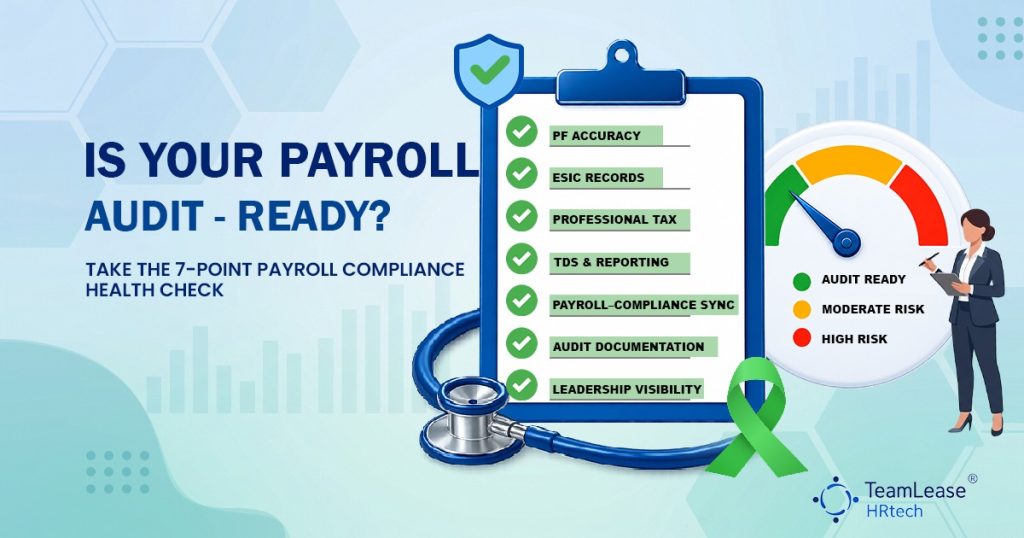
Use this checklist to assess your payroll compliance readiness.
Short on time? Take our 7-question Payroll Compliance Health Check and get an instant score.
Scoring Guide
For every question:
- Yes = 2 points
- Partially = 1 point
- No = 0 points
PF Compliance & Contribution Accuracy
The Checklist
- Are all eligible employees enrolled in PF from the date they become eligible?
- Are PF contributions calculated using the correct wage components and deposited within statutory timelines every month?
- Can you instantly produce employee-wise PF contribution records, challans, UAN data, and filing history if requested during an audit?
Why It Matters
Employers covered under the EPF Act are responsible for enrolling eligible employees, depositing contributions on time, filing monthly returns electronically, maintaining contribution records, and keeping employee UAN information updated. Inaccurate wage calculations, missed enrollments, or incomplete records are among the most common triggers for PF notices and audit observations.
Score: ___ / 6
ESIC Coverage & Record Maintenance
The Checklist
- Have all eligible employees been correctly registered under ESIC?
- Are employee entries, exits, wage updates, and contribution details regularly updated in the ESIC system?
- Can you retrieve contribution records, employee registers, and filing acknowledgements without manual effort?
Why It Matters
ESIC compliance extends beyond contribution deposits. Employers are required to maintain accurate employee records, update changes promptly, and ensure contribution data matches payroll records. Gaps often surface only when employees attempt to claim benefits or when authorities review records during inspections.
Score: ___ / 6
Professional Tax Compliance Across States
The Checklist
- Are you registered for Professional Tax (PT) in every state where your employees work?
- Are state-specific PT slabs automatically applied through payroll?
- Do you have a process to identify PT obligations when hiring remote employees in new states?
Why It Matters
Professional Tax is a state-level compliance requirement. This means rules, rates, registrations, and filing frequencies can vary significantly across states. Many compliance gaps arise when companies expand into new locations or hire remote employees without establishing the required registrations. Professional Tax is authorized under Article 276 of the Constitution and remains the employer’s responsibility wherever applicable.
Score: ___ / 6
TDS Deduction & Tax Reporting
The Checklist
- Is salary TDS calculated automatically using employee declarations and the applicable tax regime?
- Are TDS payments deposited and returns filed within statutory deadlines?
- Are Form 16s generated directly from payroll data without manual intervention?
Why It Matters
The Income Tax framework places responsibility on employers to deduct TDS on salary, deposit the tax with the government, file periodic TDS statements, and issue TDS certificates to employees. When payroll, declarations, deductions, and tax reporting are managed in separate systems, the probability of errors increases.
Score: ___ / 6
Payroll-to-Compliance Data Synchronisation
The Checklist
- Is there a single, true source of employee data for attendance, leave, payroll, and statutory calculations?
- Is compliance reporting generated directly from payroll or from spreadsheets?
- Can you identify and reconcile payroll-to-compliance mismatches before filing?
Why It Matters
Most compliance errors originate from manual reconciliation between multiple systems. Organisations become dependent on spreadsheets and manual corrections when attendance, payroll, compliance, and employee records are disconnected. These are difficult to audit and scale, especially as organisations grow rapidly.
Score: ___ / 6
Audit Documentation Readiness
The Checklist
- Can you produce statutory registers, challans, returns, employee records, and historical filings within a few hours of receiving an audit request?
- Are payroll and compliance documents stored centrally with version control?
- Have internal payroll compliance reviews been conducted in the last 12 months?
Why It Matters
Audits test documentation as much as compliance itself. Organisations may have made the right payments but still struggle if a document goes missing or cannot be traced when needed. This is very common when supporting records are fragmented across locations, email chains, or personal files. A missing document can quickly become an audit finding.
Score: ___ / 6
Compliance Visibility for HR & Finance Leadership
The Checklist
- Do HR and Finance leaders have access to real-time compliance dashboards?
- Can they monitor filing status, contribution liabilities, and exceptions before deadlines?
- Are compliance risks identified proactively rather than after notices arrive?
Why It Matters
Compliance is often treated as a back-office process until an issue surfaces. Real-time visibility helps leadership identify gaps early. This helps reduce dependency on manual follow-ups and strengthens audit readiness before regulators or auditors get involved.
Score: ___ / 6
Your Payroll Compliance Readiness Score
36-42: Audit Ready
Your payroll compliance processes appear mature, well-documented, and audit ready. Focus on continuous monitoring and exception management.
24-35: Moderate Risk
Your foundations are in place, but there are likely process gaps that could create exposure during audits, inspections, or employee escalations.
Below 24: High Risk
Your organisation may have significant compliance blind spots that increase the likelihood of penalties, notices, operational disruption, and audit findings.
From Compliance Tracking to Compliance Confidence
Payroll compliance becomes exponentially harder when employee data, attendance, payroll processing, statutory calculations, and filing workflows exist in separate systems. TeamLease HR Tech brings these processes together through a unified platform. TeamLease helps organisations automate payroll calculations, manage statutory compliance requirements across PF, ESIC, PT, and TDS. Organisations can maintain audit-ready records and gain real-time visibility into compliance health.
Find out how audit-ready your payroll function really is.
